Tuesday, 17 November 2015

Coppicing


We've made a start at cutting and sorting hazel poles up near the pylon.  This is the third winter of coppicing and we have chosen the area next to the last two coupes (coppiced areas).

We started by removing a big clump of brambles on 28th October.


Then on 8th Nov we got stuck into cutting the hazel and dogwood.  This is the easy bit. 


The harder part is choosing which bits to save as useful poles and stakes and which bits to commit to the dead hedge around the coupe.  Useful poles have to be trimmed of side branches with a billhook.


We shall be working through the winter to clear as big an area as possible.  As the hazel re-grows in each year's coupe, we shall be creating a mosaic of habitats with different characteristics: bare ground, twiggy growth, scrub and mature woodland.  Eventually after seven years, we would hope to come back round to where we started and take a new crop of poles from the same stools (roots).


Sunday, 15 November 2015

Cushion fungus


The cushion fungus (Phellinus pomaceus) usually occurs on the branches of cherry or plum trees, wild and cultivated.  I found this one on a dead branch of cherry in the old tree nursery near post 16 in Filnore Woods. 


It gets into the tree via a wound of some sort, and makes the branch brittle so that it may snap off.  Not so good, you may think but on the other hand it does a good job of clearing up dead cherry and plum trees.


Thursday, 12 November 2015

Hedgehogs

Did you cook a hedgehog accidentally on bonfire night?


A typical bonfire heap of sticks and twigs and autumn leaves is just what hedgehogs are looking for for their winter hibernation place or 'hibernaculum'.  So it's a good idea to either build the bonfire immediately before you set light to it, or look underneath.

Alternatively, build a heap of sticks and leaves specifically as a hedgehog hibernaculum.


photo: College Park Infant School, Portsmouth

I haven't seen a hedgehog in Thornbury for about 30 years, but one of our volunteers, Paul, says he has seen them in his garden recently.  Their population is in steep decline nationally, plummetting from an estimated 30 million in the 1950s to only 1.5 million now.

Nobody is sure why but it could be any or all of these:

(a) loss of hedgerows and permanent grassland - at Filnore we are trying to reverse the trend in a small way
(b) less prey - slugs, snails, earthworms, centipedes, millipedes, etc - because of pesticides
(c) smaller, tidier gardens with fences, which makes it harder to move around and find food 
(d) habitat carved up by new roads and buildings isolates small populations of hogs, which makes them more vulnerable to local extinction.

Apparently they are good swimmers, but can get stuck in garden ponds if it's hard to climb out.

photo: College Park Infant School, Portsmouth

Nov 21st  is The Day of the Hedgehog.  The People's Trust for Endangered Species is holding its annual conference for hedgehogs in Telford - I mean about hedgehogs.


Here's a link to Avon Wildlife Trust's hedgehog booklet - how to build hoghouses, how to feed hogs, how to make your garden hog-friendly.

http://www.avonwildlifetrust.org.uk/sites/default/files/hedgehog_booklet-_wild_about_gardens.pdf

and here is a link to the British Hedgehog Preservation Society

http://www.britishhedgehogs.org.uk/

Monday, 9 November 2015

Frilly Fern


At Filnore Woods we have a lot of Hart's Tongue Fern (Asplenium scolopendrium).  It has flat undivided leaves with slightly wavy edges.  I should say 'fronds' for a fern -  they're not strictly leaves from a botanical point of view.  It's the only British fern with undivided fronds.

A hart is a male red deer and the specific name 'scolopendrium' according to wikipedia, is the latin word for centipede.  This is because the brown spore cases on the back of the leaves once reminded somebody of centipede's legs.

photo:bbc gardening plantfinder

Hart's tongue is a woodland fern and prefers alkaline or limey soils, or rocks including walls.  So if you see it you can be fairly confident the soil is over limestone and therefore alkaline. 


But in the photo below, this particular specimen, growing in the old tree nursery, has extraordinarily frilly fronds.


Oh the wondrous variety of nature!

Friday, 6 November 2015

Apples and Pears


In the tunnel of the old Northavon tree nursery we have a number of unusual trees including crab apples, which have now shed their fruit. 


 It won't be wasted:  birds, small mammals and the last of the insects will relish this feast.


And up near the memorial limes at post 3, the wild pear trees we planted seventeen years ago are also fruiting


Not very tasty for humans but another feast for the inhabitants of Filnore Woods. 


Wednesday, 4 November 2015

October colour

Yarrow   

Red Campion   

Bryony berries  

Hogweed 


Yellow Aspen and red Dogwood    

Ragwort  


Guelder Rose Berries


Monday, 2 November 2015

Spiders at fattest


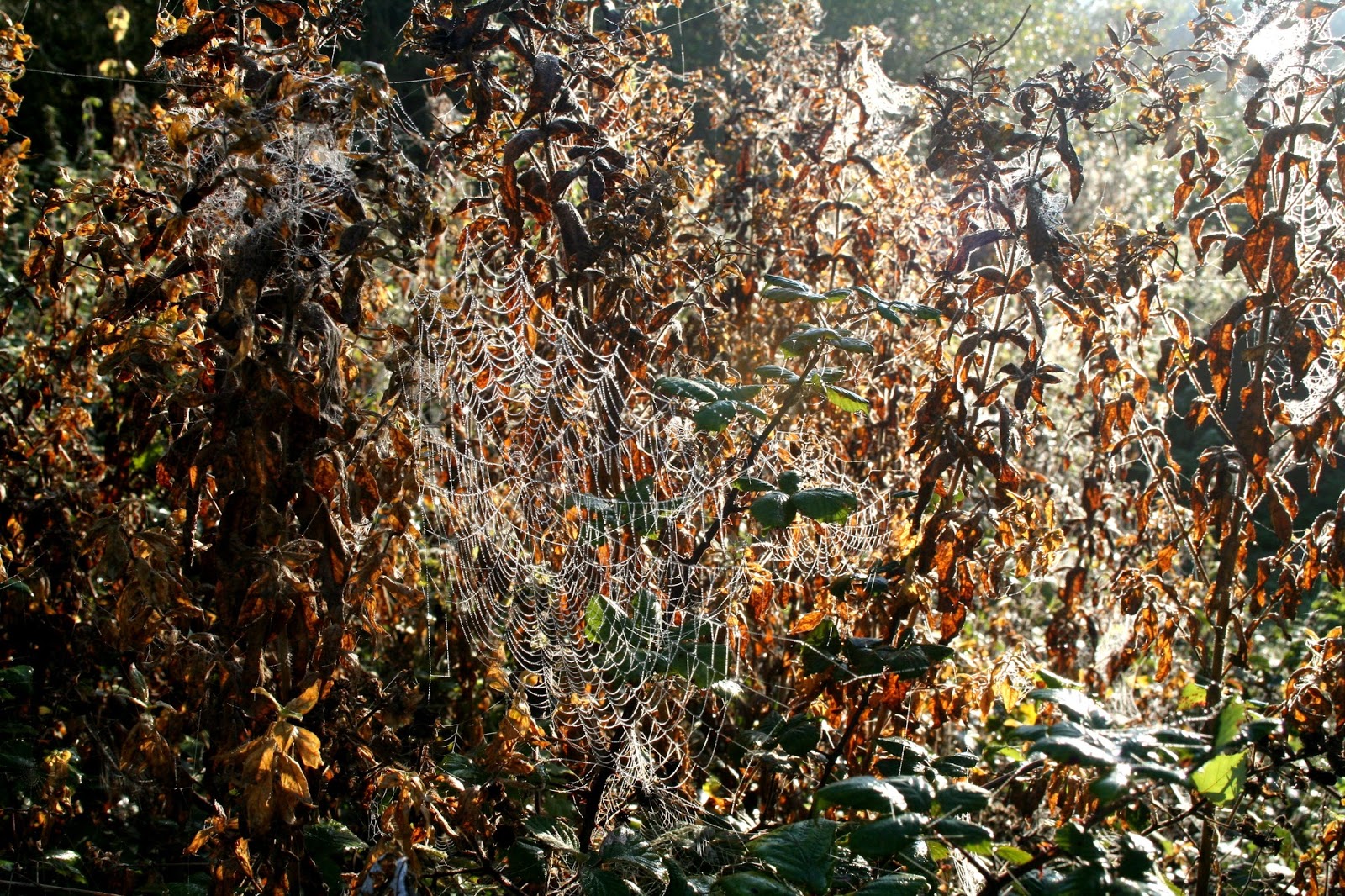
Wondrous dewy webs in the autumn sunshine


Not always easy to spot because of their habit of hiding under leaves, many spider species are at their peak.  Many of the males will have died from exhaustion (you know how it is) but females will be preparing to lay their eggs in a cocoon of silk to overwinter, and hatch into spiderlings in the spring - as orphans, sadly. 

Webs show up well on misty mornings when the dew clings to them.


Quite often the Garden Cross Spider will sit in the centre of her web, waiting for an insect to fly into the trap.


Until the killer frosts come.  


Goodbye, spiders, until next year.