Sunday, 19 September 2021

BERRY NICE

Seems to be a good year for blackberries.  Very nice stewed with apple and served with yoghurt hot or cold.  They also make a delicious bramble jelly to spread on your toast.  A gift from nature.

' What else can you offer the earth, which has everything.  What else can you give but something of yourself ' (from Braiding Sweetgrass by Robin Wall Kimmerer)


And a bumper year for sloes, the astringent fruit of the blackthorn.  


Sloe gin is rather overrated in my opinion but they do look tempting.  Offer one to a friend ! !


Some of the other berries adorning the hedgerows and woodland edges are haws on hawthorn . . . . .


. . . . . and hips on roses.


Saturday, 18 September 2021

GUELDER ROSE

Late summer and autumn deliver lots of hedgerow berries, some blue, some black and many red, but the brightest of all are the waxy berries of the guelder rose.  


It is a shrubby plant rather than a tree, rarely getting more than three metres in height


The leaves look almost like maple leaves but the plant is actually one of our two native Viburnums.


 CAUTION:  the uncooked berries can cause vomiting and diarrhoea if eaten so don't be tempted by their resemblance to red currants.


Thursday, 16 September 2021

OAK POWDERY MILDEW

Oak powdery mildew is a fungus that grows on young leaves of common oak trees.  There has been a lot of it this year, probably because of favourable weather.


It shows up from a distance but close to you can see the granular nature of the fungus.


It affects the tree in three ways:
  1. it stops sunlight getting to the leaves so that the plant can't photosynthesise so well - the leaves cannot feed the rest of the shoot and the tree as a whole
  2. the fungus continues to transpire in hot weather when an unaffected leaf would close up its pores to retain moisture
  3. without viable leaves the whole shoot can die-back

Heavily affected leaves can lead to shoot die-back

Although young leaves are colonised by the fungus, especially the second flush of leaves round about June through July and August, by September some oaks are trying again to produce new leaves which the fungus doesn't seem to be attacking.  

See the young leaves opening at the end of the shoot in the photo below.


Photos: Alan Watts


Tuesday, 14 September 2021

KNOPPER GALLS & SPANGLES

Knopper galls are knobbly growths on acorns.  They almost look like some kind of pine cone.


Now is the season for them.  Having ripened on the tree they fall off and you may first notice them on the ground beneath a mature oak tree.  Here the grubs pupate and spend the winter inside the fallen galls waiting for spring.


The tiny gall wasps that emerge from these fallen galls are, strangely, all female and their job is to seek out a Turkey Oak and lay their eggs on the catkins, where a less obvious gall develops.

The Turkey Oak (Quercus cerris) is taller and straighter than our native oaks (Quercus robur and Quercus petraea) and the leaves, as shown in the photo below, are narrower and less symmetrical than the natives.


The knopper gall wasp was first recorded in Britain in the 1950s.  It spread so that in 1979 there was a population explosion followed by a panic that our oak trees would never grow viable acorns again.  
This did not happen and there is no need to worry or try to get rid of the galls.

There are several galls that grow on oak trees and many of them have this two-generation life cycle.  You may be familiar with the marble galls that frequently occur on younger trees and the larger, softer oak apples on mature trees.

At this time of year if you notice small yellow blotches on oak leaves . . . . 


. . . . turn them over and you will find spangle galls.  There are three sorts, resulting from the egg-laying activity of three different tiny gall wasps.  The common spangle galls have a little pimple in the middle; silk button spangle galls have a dimple in the middle like a minute ring doughnut, and smooth spangle galls are - well,  smooth - with neither a pimple nor a dimple.
  

 Miniature wonders.

Thursday, 9 September 2021

REDSHANK BUT NOT THE BIRD

Redleg or Redshank (Persicaria maculosa) is inconspicuous but quite pretty when growing in a mass


There's a lot of it just above the footbridge at Filnore Woods but hurry up if you want to see it as we are intending to clear it along with all the other vegetation encroaching on to the path here.


Extra photo from Alan Watts
 

Sunday, 5 September 2021

YARROW


Yarrow (Achillea millefolium) is a late-flowering drought-resistant plant 
and is in flower now at Filnore.


The cluster of small off-white flowers is sometimes tinged pink. It is the ancestor of all the pink, yellow and orange Achilleas that are popular garden plants and sometimes the wild plants get cross-pollinated with the garden ones.


The other place you find yarrow in the garden is in lawns.  The tap-roots go deep so the feathery foliage can survive in dry weather.  I think it rather enhances a grassy lawn and if the lawn is mown it never gets a chance to flower.


 Apparently the Greek hero Achilles used the plant to heal sword wounds. Hence the name 'Achillea'; and 'millefolium' means thousands of leaves - a reference to the finely divided foliage.


Wednesday, 1 September 2021

STUMPY REGROWTH

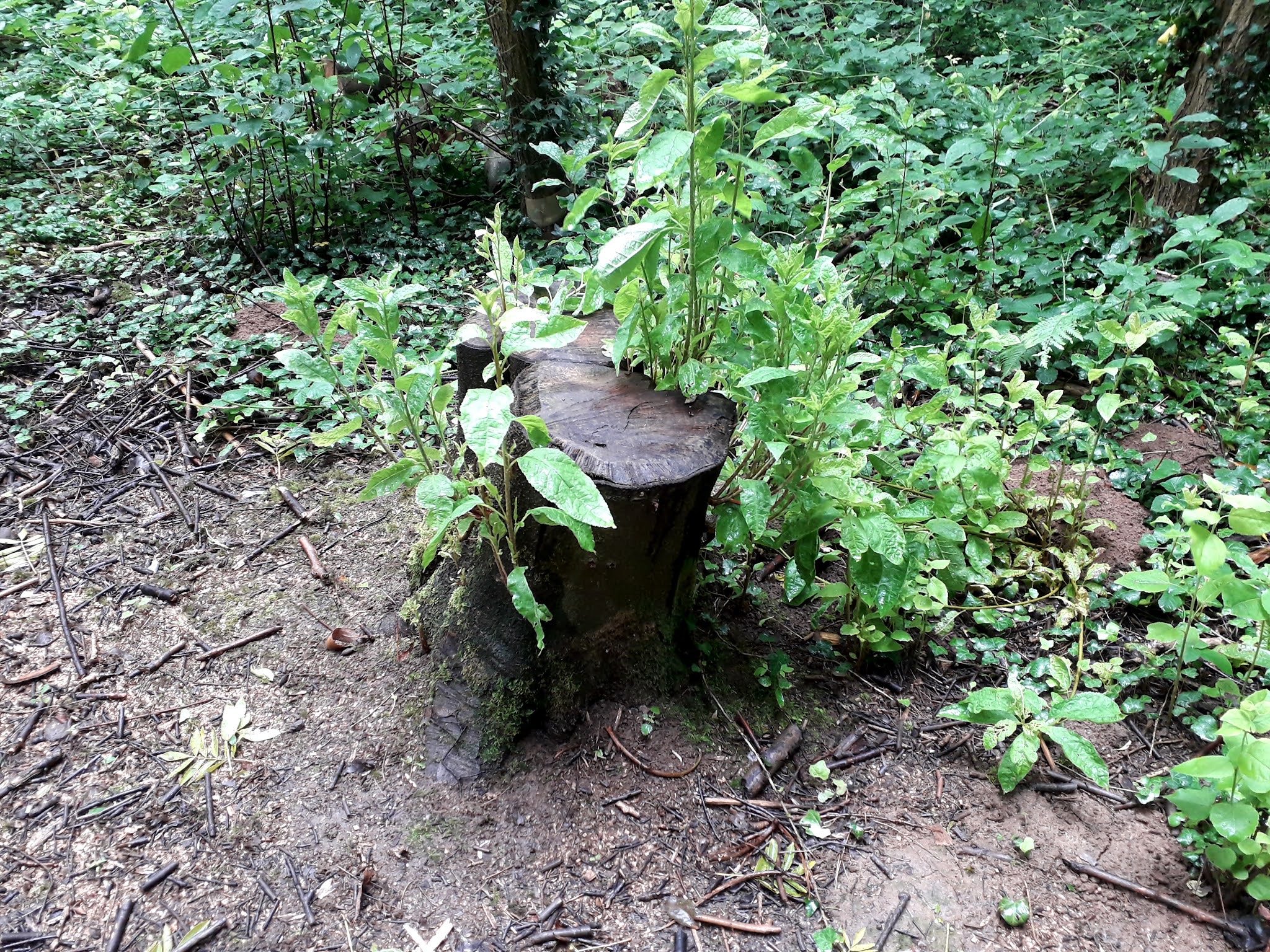
We've had to remove two trees this year because of the hazard posed by dead and broken branches but see how they are re-growing.

The Bird Cherry stump was cut almost to ground level and is now sprouting from the root. 


And the Sallow that was left as a five foot high stump has sent out shoots all round.


Rather than destroyed these trees have effectively been coppiced.  It will be interesting to see how they develop.  Will they become trees again or will we have to re-coppice them for the sake of safety?  They could then provide us with a supply of poles too.