Saturday, 21 December 2013

Using our coppiced material

Having started coppicing some of the hazel at Filnore Woods, we began sorting it for different uses.  The larger poles were used for edging paths where the camber needed correcting.


Here's Eric surveying his handiwork. 
 
 
And the short thin bits were used to make stakes to hold the poles in place..


Here's Derek sharpening stakes.
 
 
And Will, drilling and nailing the poles to the stakes.
 
 
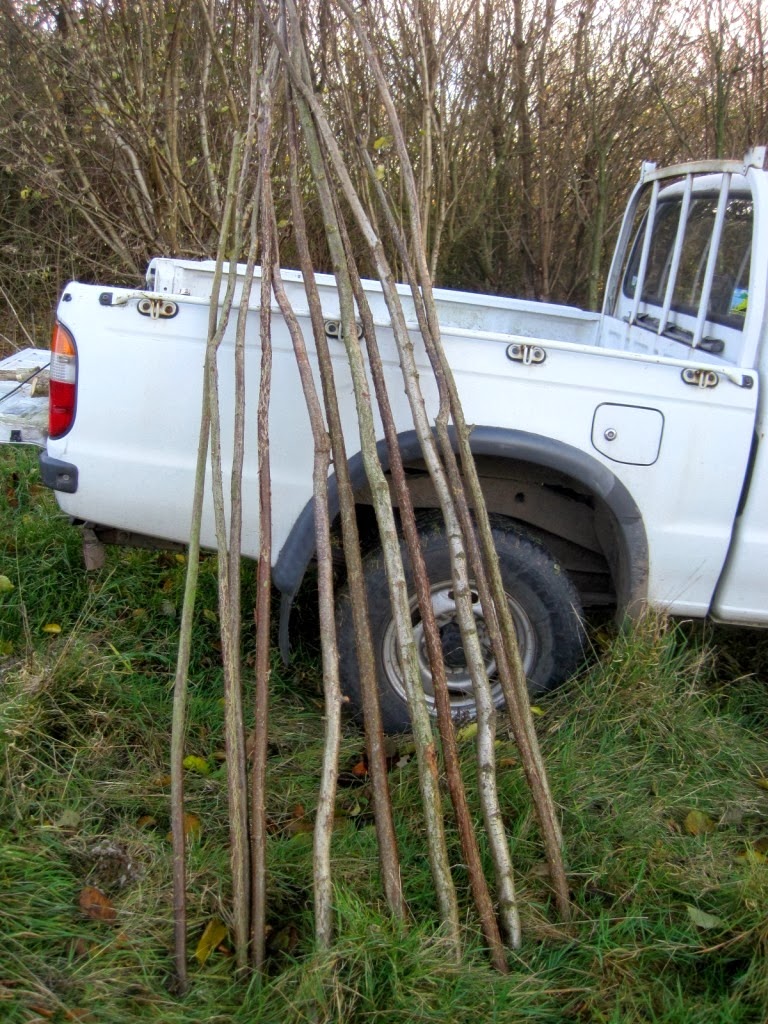
Any poles that were not too thick and fairly straight were saved as beansticks for next spring.


And the lumpy bits were given to the Compost Boys for them to sell as firewood.  Filnore Friends are extremely grateful to the Compost Boys for donating £250 to us from their sales of compost and firewood.


Monday, 16 December 2013

Twit of the day

Somewhat appalled to hear David Attenborough saying on the 'Today' programme this morning that one bird he could recognise by its song was the one that was supposed to say, "a little bit of bread and no cheese."  He said it was the chaffinch whereas it is usually taken to be the yellowhammer.
 
                                                     Chaffinch                                           Yellowhammer (Andy Bright on Bird Forum)

Even more appalled that listeners phoned in and suggested it might be the chifchaff !!   Can't expect the troglodyte programme presenters to know about birdsong but these listeners and Attenboroughs are supposedly experts.

Chiffchaff
 
Listen to the songs of chiffchaff and chaffinch on Brett Westwood's birdsong recordings on


 or all three on the rspb website at


Trees from a distance

Up near post 4 you can easily distinguish between the rounded oaks, covered in orange leaves and the tall upright stems of Aspen trees
 
 
Looking downhill from post 3, recognise the Hazel on the right here, because it has so many stems growing from the same root.


And in the picture below, looking from post 2 towards post 1, we feature the Ash.  To left and right you can see ash keys (the seeds hanging at the ends of the twigs), and those two big, bare trees with ivy on the trunks and lower branches, at the end of the path, are also ash.


Here are the same two ash trees viewed from the allotment field.

 
Where the branches are within reach you can be certain to identify the Common Ash (Fraxinus excelsior) correctly in winter because of the black buds.


Thursday, 12 December 2013

Tool store

Located by Mike of Alan Coward Transport at Avonmouth, we now have our lockable tool store.  Standing forlornly amongst all the other, larger containers, we could see she needed re-homing. 

 
She is rather a startling white at the moment.  Suggestions for a less obtrusive appearance are welcome from all and sundry.  Email your ideas to filnorefriends@gmail.com 


Inside there is already some shelving in place.


Unfortunately the ground was too soft for the truck which brought her, so she was left just inside the field gate.  But thanks to Willy Grey and his John Deere tractor, Connie the container is now happily at her country seat.  It was touch and go getting her through between the ash trees, as Willy could not see where he was going with the container carried in front of the tractor.  We'll be showing the video at our AGM in April.  Don't miss it.


She is already useful as a store for our tools, which are now locked securely away.  We have also stored some beansticks inside in the dry, which we have harvested ready for the spring.


Sunday, 8 December 2013

Long-tailed tits

These little balls of pinky-white fluff with long dark tails are constantly on the move in small family groups.
 
photo:    London Bird Club

You may not see them at first but you may hear their high-pitched squeaks "dibbedy-dee"   "dibbedy-dee", which they use to keep together.
 
They have tiny beaks, bushy black eyebrows and 'peppercorn eyes'.
 
photo:  Roger Wyatt, Oxfordshire Bird Log
 
We know that they nest at Filnore Woods because we found a nest in the brambles.  See the post for 29th March 2012.

Wednesday, 4 December 2013

Young enterprise

In a community woodland, a variety of activities take place. 
I wonder whether this sudden crop of pallets and padded seats is for a housebuilding exercise or a bonfire.
 
 
As long it doesn't harm the tree or spoil other people's enjoyment of the woods, let's see what happens.  It must have taken some effort to get these materials here.
 
Does anyone know what is going on?

Sunday, 1 December 2013

Spindle tree

Here's another berry spotted today in Filnore Woods.

 
The Spindle Tree produces coral-pink berries divided into four quarters.  When the berry splits open, the bright orange seeds hidden inside can fall out.
 
 
Spindle twigs are four-cornered, square in section, and very straight.  This made them good for skewers and for spindles for hand spinning.