Friday, 13 February 2015

Oh deer

Where the fallen, dead silver maple has been chopped up, near post 16 on the self-guided trail, some of the branches lying on the ground have had the bark gnawed off. It could be hungry rabbits, but I think it is more likely to be deer.
 
 
Further evidence of deer is this attack on an apple tree a bit further down the path.  Apple bark is a favoutrite with deer and we have seen this before at Filnore.

 
Of the six free living species of deer in Britain, it is most likely to be Roe Deer in our woods, although Muntjac and Fallow Deer also live locally.  Deer are most active at dawn and dusk. 
 
Last year, just before our 5.00 am Dawn Chorus Walk, Anita saw two fallow deer in the Leisure Centre car park.  They didn't come on our walk though.  Perhaps they were waiting for the swimming pool to open.
 
 
fallow deer - alan spellman, www.mullbirds.com


roe deer - photo of unknown origin


Tuesday, 10 February 2015

Hedge laid

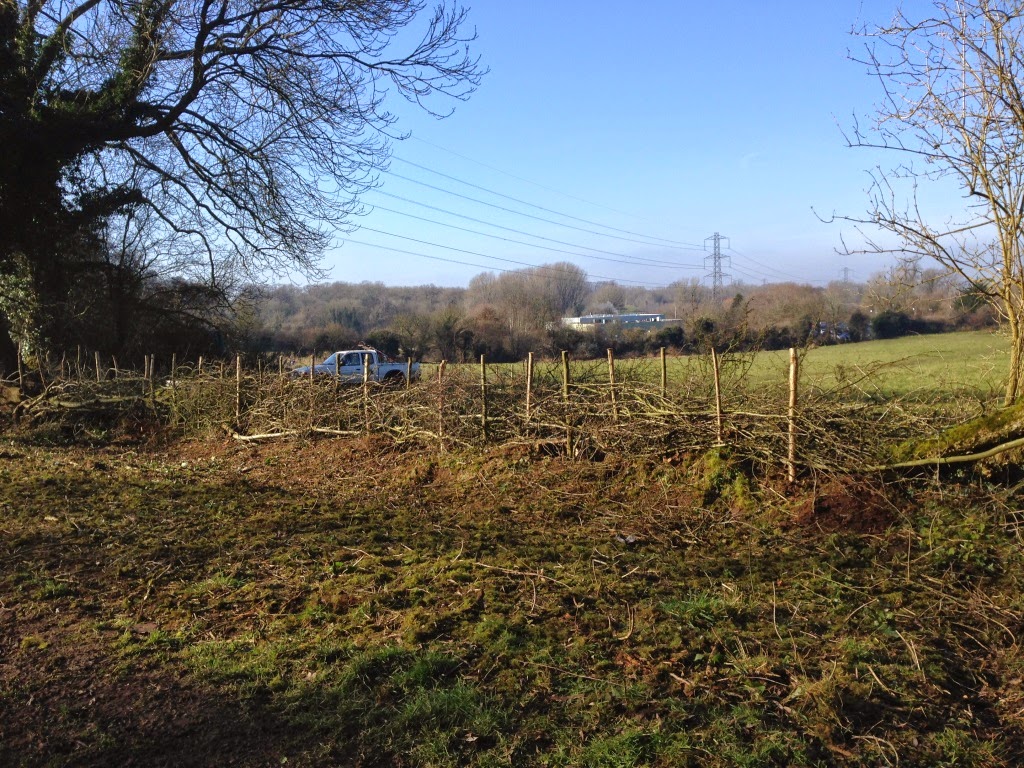
After much hard effort we have succesfully laid a section of old hedge.  This is what it looked like a few days ago.
 
 
First there was some more elder to remove. Elder's big leaves and sappy growth cause gaps in the hedge if it is left.

 
While doing this a lot of barbed wire was encountered, cut out and coiled for disposal, along with an old bedstead and other bits of hardware.

 
And then the lower branches of the hawthorns were cut back to enable the stems to be laid almost flat.  An early start was made this Sunday morning.
  
 
We were now totally committed having decimated what was left of the hedge. 

The ivy was pulled off the remaining trees.
 
 
and raked up from the ground.
 

Some new hawthorns and hazels were planted in the gaps.
 
 
Sharpened stakes of hazel were brought down from the coppice coupe, and hammered into the ground along the top of the hedge bank.
 
 
 Then we cut out the big stems of hawthorn and half-severed the remainder (now called 'pleachers) so they could be bent over and woven between the stakes.


The elder and ivy were dragged to the fire site and burned.


And our laid hedge is now waiting the finishing touches.


Thursday, 5 February 2015

Hedge to be laid

 
Just inside the main entrance to Filnore Woods there is a short length of old hedgerow which we intend reconstituting as a laid hedge.
 
We have already cut out quite a lot of the elder, which is no good for hedging, and cleared much of the undergrowth.  There's still a bit more elder to excise.  As you can see in the picture above, all we shall have left are a few knobbly old hawthorns in a rather uneven hedge bank.
 
We shall atempt to lay these by cutting part way through the stems at the base and folding them into a near horizontal position, something like this old hedgerow in Thornbury, which was laid in February 2011. 
 
 
Then we shall beef up the resulting hedge by weaving hazel poles and brushwood between one row of vertical stakes to create a temporary fence. 


The top is finished off with 'hetherings', long thin lengths of wood, twisted together to lock the rest in place.


Hopefully the horizontal hawthorn will send up shoots along its length, creating a dense but manageable hedge.


That is the aim we aspire to. 
Watch this space.


Don't take my word for it see what the Woodland Trust has to say about hedges and their importance to wildlife and hence to us all.
 
Click on this link


Monday, 2 February 2015

Birds at Filnore

Rob Collis's bird survey chart for 2014.

As you can see, some of our birds (blackbird, blue tit, crow, chaffinch, herring gull, magpie, robin, wood pigeon and wren) are there all the year round, while others have only been seen or heard once (garden warbler, great spotted woodpecker, mistle thrush, pheasant, pied wagtail) or twice (swift and whitethroat).  You can also make out the summer visitors like blackcap and chiffchaff.  Can you see any other trends?

FILNORE WOODS BIRD SURVEY 2014                    
SPECIES JAN FEB MAR APR MAY JUN JUL AUG SEP OCT NOV
BLACKBIRD 9 9 11 14 19 9 10 8 4 15
BLACKCAP 6 10 6 1 2 1
BLUE TIT 11 14 8 12 5 3 4 4 7 9
BULLFINCH 3 2 3 2 2 1 1 5 4
BUZZARD   1 1 1
CARRION CROW 2 11 4 4 3 6 9 7 4 2
CHAFFINCH 6 6 2 10 3 3 5 3 25 2
CHIFFCHAFF 14 8 9 6 6
COLLARED DOVE 1 2 3 2
DUNNOCK 1 6 9 4 3 3 2 2
FIELDFARE
GARDEN WARBLER 1
GOLDCREST 1 1 2 1 2
GOLDFINCH 2 2 8
GREAT SPOTTED WOODPECKER 1
GREAT TIT 5 9 5 2 2 1 1 2
GREEN WOODPECKER 1 1
GREENFINCH 5 5 5 11 2 3 5
HERRING GULL 2 5 3 5 3 1 7 3 2 4
HOUSE MARTIN 12
JACKDAW 1 1 1
JAY 1 2 1 1 2 2 1 1 2
LESSER BLACK-BACKED GULL 2
LESSER WHITETHROAT
LITTLE OWL
LONG-TAILED TIT 2 2 2 1 3 3 5
MAGPIE 6 4 4 2 3 3 5 3 4 1
MISTLE THRUSH 1
PHEASANT 1
PIED WAGTAIL 1
RAVEN 1 1 1
REDWING 2 17
ROBIN 8 6 6 5 8 3 1 14 13 8
ROOK
SONG THRUSH 2 1 1 3 1 1
SPARROWHAWK 1 1
STARLING 20 3 1 2
STOCK DOVE
SWALLOW 2
SWIFT 2 2
TAWNY OWL 2
TREECREEPER
WHITETHROAT 1 2
WILLOW WARBLER 1
WOODPIGEON 19 33 26 50 26 25 34 32 12 18
WREN 3 2 4 15 11 10 4 6 3 5


Many thanks to Rob for doing this every month.  Do we have any other amateur expert surveyors for other groups like fungi, woodlice, mosses or such?  Get in touch if you would be able to offer your expertise.  filnorefriends@gmail.com.