Wednesday, 19 March 2014

Signs of spring - Chiffchaff singing in Filnore Woods

Robins and wrens sing all through the winter but now the other birds are starting to claim their territories.  I have heard Blackbirds, Chaffinches, Great Tits, Blue Tits and Green Woodpeckers this week at Filnore.  But the one I enjoyed the most was the Chiffchaff.  It sounds like a real sound of spring to me. 

They nest on the ground in scrub but they like a high perch on a tree to sing their "chiff chaff chiff chaff" song.  I found this brilliant 47 second video by David Hickson on YouTube.  It shows you the song and the singer.

 
Watch out for our Dawn Chorus Walk coming soon.  We haven't fixed a date yet but it will probably be in late April, very early on a Saturday or Sunday morning.  All welcome.  No charge.

Monday, 17 March 2014

First coppice coupe nearly finished

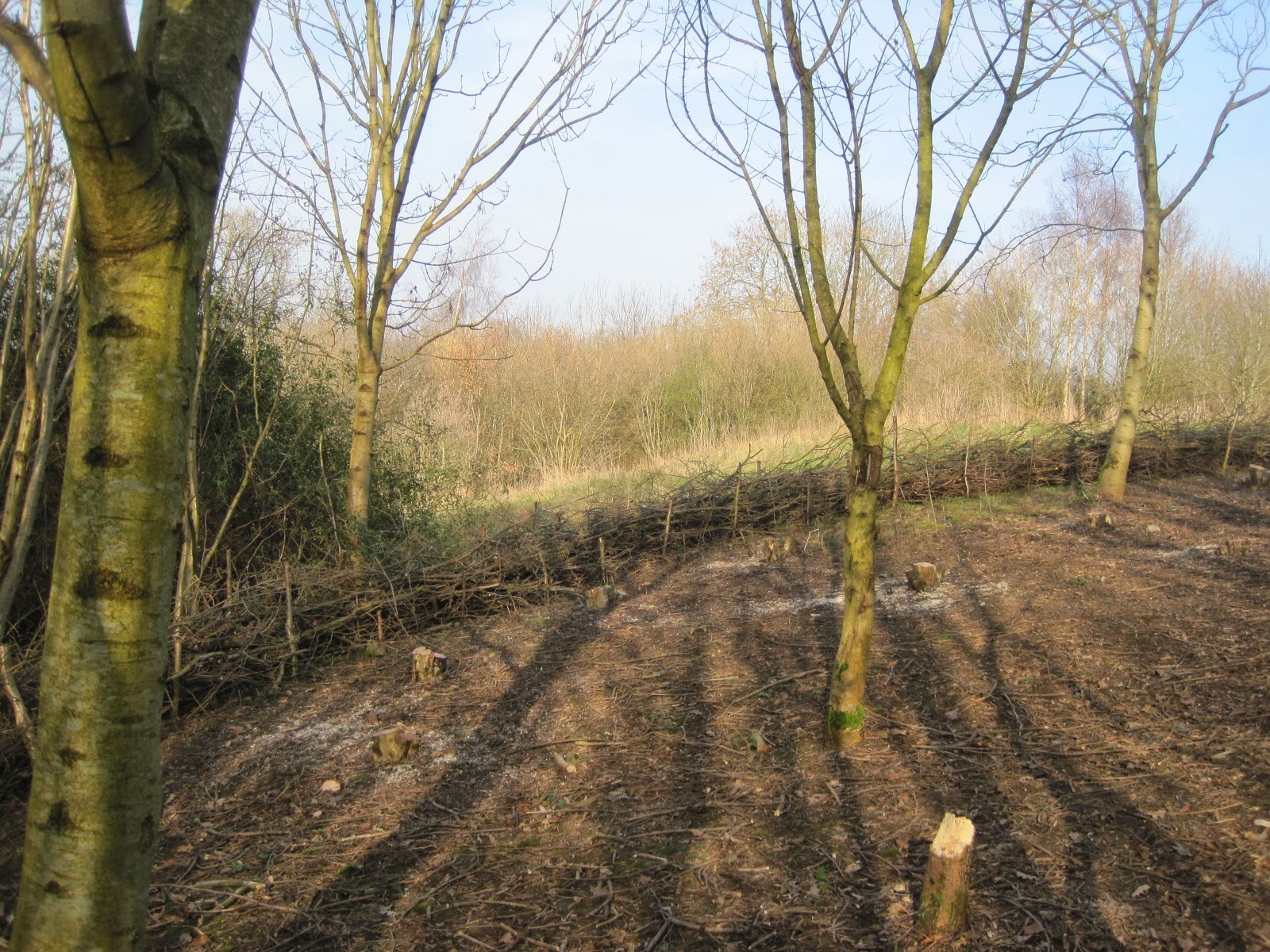
After two years of attending to the paths and brambles, we have actually started managing the woodland.  This small coppice coupe is near the pylon, as you can see in the photo below.


We have coppiced the hazel and felled a few trees to give the remaining ones a better chance.  Too many trees too close together do not thrive and if no light gets to the woodland floor we get little in the way of ground flora.  We want a rich woodland environment with plants, insects birds and mammals.


We have produced a lot of poles, some of which we hope to sell for beansticks and plant stakes in a month or so's time.  In the tool store we have several bundles of ten x 8' beansticks and a few bundles of five x 5' hedging stakes.
 
 
There is also some bigger wood which we may use to make a bench or two.

 
Not all the cut wood is useable.  There is a lot of twigyy stuff and some curly and knobbly sticks.  These have been made into a 'dead hedge' around the perimeter of the area we have coppiced, known as a 'coppice coupe'.  This will soon rot down but meanwhile the floor of the coupe is easier to move around and the hedge will show us next winter where we cut this year.  If we continue to get such good support from our volunteers, we hope to cut a coupe each year.  By the time we have done most of the woodland, this first coupe will be ready for cutting again.

The dead hedge
 

Saturday, 15 March 2014

Thursday, 13 March 2014

Butterflies spotted at the weekend in the spring sunshine

 
This Peacock butterfly photographed at Filnore Woods by Simon, is one of the earliest to emerge this spring.  There have also been Small Tortoiseshells and a Comma butterfly seen.  But the earliest, as usual, has been the greeny yellow Brimstone butterfly.  They are harder to photograph because, unlike the Peacocks, Brimstones don't spend much time perching.
 
 
You can just make one out in the top left quarter of this photo.

Wednesday, 12 March 2014

Ladybirds sunbathing

Last Sunday's sunny weather brought out these little characters
 
Photo: Simon Harding
  
They were literally sunbathing.  Insects need to warm up before they can get to operating temperature. 
 
Seven-spot ladybirds are one of the three commonest ladybird species in the UK.  There are about two dozen species and the other most common ones are the pine ladybird (red spots on black and lives on pine trees), the two-spot (black spots on red or red on black) and the 14-spot (yellow and black).

Friday, 7 March 2014

Preserving wildlife - a message to pass on


We are very grateful to dog walkers who bag up their dog's faeces and take it away.  There are two well-used dog-bins just by the field gate of the car park.  Thank you.
 
But I'm afraid bagging it up and leaving it on the ground is not much good.  The stuff will be nicely preserved inside its plastic bag.  Really it's worse than not clearing up at all. 
 
 
 I found four parcels this week.


This one was easy to retrieve, nicely placed by the noticeboard.
 

But this one has been around a while.  It's easy to see but hard to reach in the middle of a bramble bush.

 
  Unfortunately we have to pick these offerings up and take them to the bin ourselves.

 So please pass this message on:  "Bag it up and TAKE IT AWAY".

Monday, 3 March 2014

The need to cut branches and sometimes whole trees

There are four main reasons we cut trees at Filnore Woods.
 
1. To coppice trees so that they re-shoot and produce numerous stems - this is especially done on hazel.
2. To thin the number of trees so that they don't grow too tall and spindly.  Expect to see more of this thinning in future as we have allowed our trees to grow a bit too close to each other for too long. 
3. To make paths safe and passable by cutting off projecting branches that could poke out an eye or rip a coat.
4. To remove fallen trees and dangerously leaning trees.  We have had to cut off several willows, silver maples and some dogwood stems in the old tree nursery, that had fallen across paths.
 
The photo below shows a dead stem on a silver maple tree in the former Northavon tree nursery near post 16.  (In the photo you can see post 16 through the gap between stems.)  This dead stem needs to be cut off before it breaks.  As well as being dead it's leaning at an angle of 20 degrees from the vertical. 
 
The silver maple behind and to the left is alive but the stem is damaged and it's leaning at about 45 degrees.  I have been keeping an eye on it and it appears to be subsiding.  So I'm afraid it will also have to be felled soon.  We don't want anyone getting injured.
 
 
And this beech tree near post 14 surprised us by up-rooting last week. 
 
 
High winds and soft, wet soil probably helped, but there must have been some weakness or decay in the roots. Most trees don't fall over.
 
 
Some small branches have been removed so you can get past.  We may use the trunk wood to make a bench seat later in the year.